

The Most In-Demand ServiceNow CIS-EM Pass Guaranteed Quiz
New Version CIS-EM Certificate & Helpful Exam Dumps is Online
The benefits of obtaining the ServiceNow CIS-EM certification are numerous. Firstly, it demonstrates a high level of expertise in the ServiceNow platform, which can help professionals stand out in a competitive job market. Secondly, it provides a clear understanding of the Event Management application within ServiceNow, which can improve operational efficiency and reduce downtime. Finally, having the certification can lead to higher salaries, promotions, and other career opportunities.
What is the format of the ServiceNow CIS-EM Exam
Exam Format: Multiple choice questions
Exam Length: 65 questions
Exam Duration: 90 minutes
Language: English
Passing score: 70%
ServiceNow CIS-EM certification program covers a variety of topics, including event management fundamentals, event correlation, event rules, notifications, metric monitoring, and reporting. Candidates who are interested in earning this certification must pass a rigorous exam that tests their knowledge and skills in these areas. Certified Implementation Specialist-Event Management Exam certification is an excellent way to showcase your skills and knowledge to potential employers, and it can help you stand out in a competitive job market.
NEW QUESTION # 45
What is the default collection/polling interval applied to all event connectors?
- A. Every 60 seconds
- B. Every 10 seconds
- C. Every 40 seconds
- D. Every 5 seconds
- E. Every 120 seconds
Answer: B
NEW QUESTION # 46
What missing attribute would cause an event to have a state of Error?
- A. Metric Name
- B. Classification
- C. Severity
- D. Node
- E. Source
Answer: C
NEW QUESTION # 47
What are the server requirements to allow Operational Intelligence to successfully collect operational metric data via a push?
- A. This requires a minimum of two MID Servers - one for Event Management and one additional MID Server dedicated for use by Operational Intelligence (OI).
- B. This requires a MID Web Server in addition to the MID Server.
- C. This requires a minimum of three MID Servers - two for Event Management and one additional MID Server dedicated for use by Operational Intelligence (OI).
- D. Nothing additional is required; this is handled by the MID Server.
Answer: B
NEW QUESTION # 48
What is the default collection/polling interval applied to all event connectors?
- A. Every 60 seconds
- B. Every 10 seconds
- C. Every 40 seconds
- D. Every 5 seconds
- E. Every 120 seconds
Answer: B
Explanation:
Reference: https://docs.servicenow.com/bundle/orlando-servicenow-platform/page/use/collaboration/task/ t_ConfigureThePollingInterval.html
NEW QUESTION # 49
What is one of the benefits of using alert automation in Service Operations Workspace?
- A. It does not require any knowledge of the source event collection tool
- B. It uses back end tables separate from those in event management rules
- C. It enables centralized administration for all alert management
- D. It offers a simplified experience for creating and managing event and alert related rules
Answer: D
NEW QUESTION # 50
The default polling time to collect events from an event source is:
- A. 120 seconds
- B. 30 seconds
- C. 5 seconds
- D. 60 seconds
Answer: A
NEW QUESTION # 51
Given the following Impact settings and Alerts in a three node cluster that makes up the components of a Business Service, what is the overall service health of this Business Service?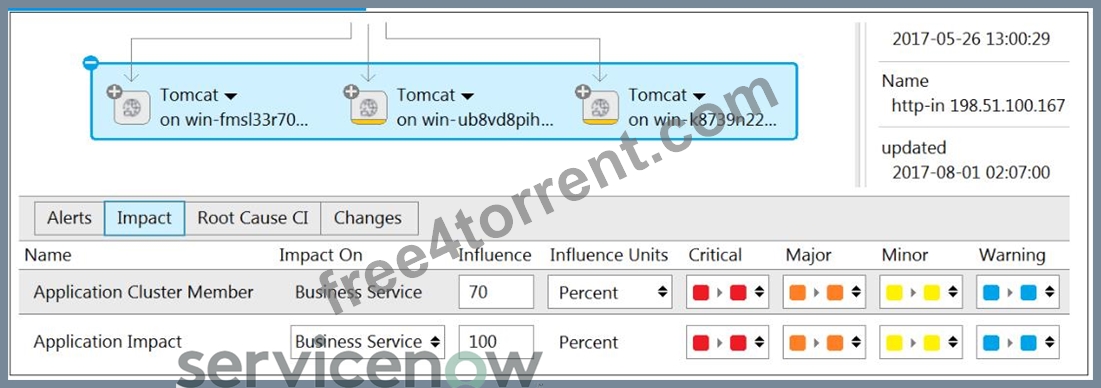
- A. Major
- B. Error
- C. Minor
- D. Warning
- E. Critical
- F. Clear
Answer: F
NEW QUESTION # 52
In your environment, no alert CMDB, automated, or text based grouping is occurring. What is most likely the problem?
- A. No CMDB is configured
- B. The alert correlation property that enables grouping is set to false
- C. No event management rules have been defined
- D. Application services are not operational
- E. No correlation rules have been defined
Answer: A
NEW QUESTION # 53
When creating event rules, is it best practice to create:
- A. As many rules as possible
- B. As few rules as possible
- C. One rule for every event
- D. Two rules for every event
Answer: C
NEW QUESTION # 54
Which attribute is responsible for de-duplication?
- A. Short_description
- B. Additional_info
- C. Message_key
- D. Metric_name
Answer: C
NEW QUESTION # 55
Where can you look to determine what event rule created an alert? (Choose two.)
- A. Event Additional Information
- B. Alert Activity
- C. Alert Message Key
- D. Event Processing Notes
- E. Alert Source
Answer: B,E
Explanation:
Explanation/Reference: https://docs.servicenow.com/bundle/orlando-it-operations-management/page/product/event- management/task/t_EMViewRuleApply.html
NEW QUESTION # 56
What does Operational Intelligence proactively identify before they cause service outages?
- A. Alert correlations
- B. Defects
- C. Anomalies
- D. Orphaned CIs
- E. Missing CMDB data
Answer: C
NEW QUESTION # 57
What two key steps must be performed after creating a new connector instance? (Choose two.)
- A. Test the connector
- B. Enter credentials for the connector
- C. Assign a MID Server to the connector
- D. Debug the connector
- E. Activate the connector
Answer: A,E
NEW QUESTION # 58
What applications are included in the ITOM Health solution?
Choose 3 answers
- A. Event Management
- B. Discovery
- C. Agent Client Collector
- D. Health Log Analytics
- E. Cloud Provisioning and Governance
- F. Service Mapping
Answer: A,C,D
NEW QUESTION # 59
What are the two most accurate statements regarding the ServiceNow CMDB (configuration management database) and CIs (configuration items)?
- A. The CMDB is a dynamic list that tracks both the CIs within your platform and the relationship between those items.
- B. A CI is any component within your infrastructure that needs to be managed in order to deliver Services.
- C. The CMDB is a series of tables that contain only key hardware components located in critical paths within your platform that must be managed.
- D. All CIs stored in the CMDB must have an assigned IP address within your infrastructure.
Answer: A,B
Explanation:
Explanation/Reference: https://docs.servicenow.com/bundle/orlando-servicenow-platform/page/product/configuration- management/concept/c_CIRelationships.html
NEW QUESTION # 60
A support agent resolves an incident associated with an alert, but the alert does automatically close even though the evt_mgmt.incident_closes_alert property is set appropriately to close the alert.
What is the most likely cause of this issue?
- A. The support agent does not have the evt_mgmt_user role.
- B. The support agent only has the evt_mgmt_admin role.
- C. The support agent has the evt_mgmt_user role, but not the evt_mgmt_operator role.
- D. The support agent has the evt_mgmt_operator role, but not the evt_mgmt_user role.
Answer: A
NEW QUESTION # 61
What event will cause Agent Client Collector self-monitoring to pause data collection?
- A. The amount of host disk space used by the agent exceeds a threshold
- B. The amount of host CPU being utilized by the agent exceeds a threshold
- C. The amount of host memory being used by the agent exceeds a threshold
- D. Communication with the ServiceNow instance is lost
- E. Communication with the MID server is lost
Answer: B
NEW QUESTION # 62
By default, the Alert Console displays what type of alerts?
- A. All Primary, Open alerts with a Severity of Critical, Major, Minor, and Warning that are not in Maintenance mode
- B. All Primary, Open alerts and anomaly alerts with a Severity of Critical, Major, Minor, and Warning that are not in Maintenance mode
- C. All Primary and Secondary Open alerts and anomaly alerts with a Severity of Critical, Major, Minor, and Warning that are not in Maintenance mode
- D. All Primary alerts with a Severity of Critical, Major, Minor, Warning that are not in Maintenance mode
- E. All Primary and Secondary Open alerts with a Severity of Critical, Major, Minor, and Warning that are not in Maintenance mode
Answer: E
NEW QUESTION # 63
A four node cluster makes up the components (CIs) of a Business Service. The impact influence for the cluster is set to 60%.
How many members of the cluster must be in a Critical state in order for the Business Service to display as Critical in the Impact Tree?
- A. 0
- B. 1
- C. 2
- D. 3
Answer: D
NEW QUESTION # 64
For an incoming event with a matching message key, what allows an existing alert to be automatically closed?
- A. In the event rule, set the Severity to 0
- B. In the event rule, set the Severity to -1
- C. In the alert rule, set the Severity to 0
- D. In the alert rule, set the Severity to -1
Answer: B
NEW QUESTION # 65
......
CIS-EM Free Certification Exam Material with 118 Q&As : https://pass4sures.free4torrent.com/CIS-EM-valid-dumps-torrent.html