

Use the best ways of preparing for NS0-593 Exam Dumps with Free4Torrent Network Appliance NS0-593 dump PDF [2024]
Network Appliance NS0-593 exam candidates will surely pass the Exam if they consider the NS0-593 dumps learning material presented by Free4Torrent.
NEW QUESTION # 20
You Just used the CLI to create a NetApp ONTAP FlexGroup Volume on a NetApp Cloud Volumes ONTAP
instance. After creation, you notice odd behavior in NetApp Cloud Manager.
In this scenario,what Is the reason for this behavior?
- A. Cloud Volumes ONTAP does not support FlexGroup volumes.
- B. The Capacity Management Mode within Cloud Manager should be set to Manual.
- C. Cloud Manager must be used to provision the FlexGroup volume.
- D. The Capacity Management Mode within Cloud Manager should be set to Automatic.
Answer: C
NEW QUESTION # 21
Which two automation methods does NetApp ONTAP Select support? (Choose two.)
- A. REST
- B. Docker
- C. Anslble
- D. PHP
Answer: A,C
Explanation:
= ONTAP Select supports REST and Ansible as automation methods. REST is the primary foundation for the automation technologies, and Ansible is a popular tool for automating ONTAP Select deployments using roles and playbooks. Reference = ONTAP Automation documentation, Automate ONTAP Select deployments with Ansible
NEW QUESTION # 22
You are attempting to connect a NetApp ONTAP cluster to a very complex network that requires LIFs to fail
over across subnets.
How would youaccomplish this task?
- A. Configure a I IF failover policy for each subnet inside a single broadcast domain.
- B. Configure VIP LIFs using OSPF.
- C. Configure an equal number of UFs on each subnet.
- D. Configure VIP LIFs using BGP.
Answer: D
NEW QUESTION # 23
Your customer is running a NetApp AFF A800 system with NetAppONTAP 9.8 software and states that their
NS224 shelf is not showing with the correct shelf ID. You analyze the data and the shelf shows an
identification of "1.SHFHUXXXXXXXXXX."
What is the cause of the reported Issue?
- A. The shelf had a disk replaced too quickly.
- B. The shelf has been power cycled.
- C. A new shelf was added to the controller.
- D. The shelf was cabled Incorrectly.
Answer: C
NEW QUESTION # 24
You are deploying NetApp ONTAP Select. When trying to add VMware vCenter to the inventory, you receive
the message shown below.
Credential authentication failed for x.x.x.x with: HostConnectionFailed
In this scenario, how would you correct this problem?
- A. Change the gateway address of the ONTAP Select Deploy VM.
- B. Change the IP address of the ONTAP Select Deploy VM.
- C. Change the vCenter password.
- D. Change the IP address of the vCenter server.
Answer: C
NEW QUESTION # 25
A customer is calling you to troubleshoot why users are unable to connect to their CIFS SVM.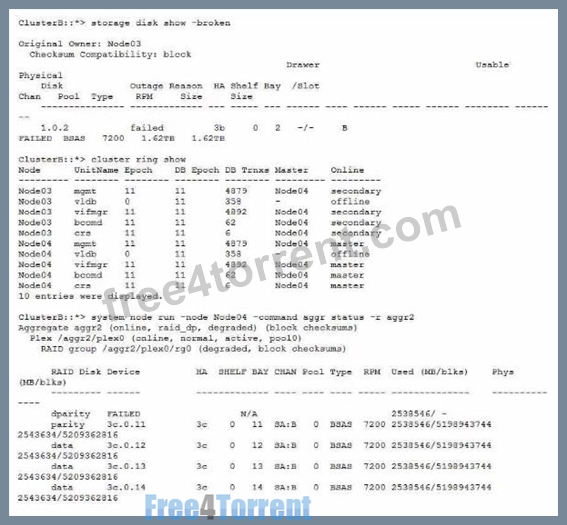
Referring to the Information shown in the exhibit, what Is the source of the problem?
- A. The aggregate aggr2 has a failed disk.
- B. The databases On Node03 must be Switched from secondary to master.
- C. Thev1db database is offline.
- D. The broken disk in Node03 is the source of the problem.
Answer: B
NEW QUESTION # 26
After expanding a two-node AFF A300 cluster with two AFF A700 nodes, you observe latencies when data is accessed indirectly. The system node run -node -command netstat command shows retransmits and packet drops on the LIFs. The AFF A700 nodes with 40 Gbps and the AFF A300 connect with 10 Gbps to the cluster interconnect. You are using Cisco Nexus 3132Q cluster interconnect switches. You just updated to ONTAP 9.8 software.
In this scenario, what is causing this problem?
- A. There is an NXOS firmware mismatch, verify in the Interoperability Matrix (1MTJ for a supported version.
- B. The 10 Gbps to 10 Gbps cluster Interconnect is creating a speed mismatch.
- C. AFF A300 and AFF A700 node mixing Is not supported in ONTAP 9.8 software.
- D. The AFF A300 Is using an adapter card for the cluster Interconnect, but only onboard ports are supported.
Answer: B
Explanation:
A speed mismatch occurs when the cluster ports on different nodes have different speeds, such as 10 Gbps and 40 Gbps1.
A speed mismatch can cause packet loss, retransmits, and latency on the cluster network, especially when data is accessed indirectly, meaning that the node serving the data is different from the node hosting the LIF2.
In this scenario, the AFF A300 nodes have 10 Gbps cluster ports, while the AFF A700 nodes have 40 Gbps cluster ports, creating a speed mismatch on the cluster interconnect34.
The Cisco Nexus 3132Q cluster interconnect switches support both 10 Gbps and 40 Gbps cluster ports, but they have a shallow buffer size of 9 MB per port, which can be easily overwhelmed by the bursty traffic generated by the speed mismatch.
To solve this problem, you need to either upgrade the cluster ports on the AFF A300 nodes to 40 Gbps, or downgrade the cluster ports on the AFF A700 nodes to 10 Gbps, to achieve a homogeneous cluster interconnect1.
Alternatively, you can use QoS policies to limit the bandwidth of the cluster ports to avoid oversubscription and congestion on the cluster interconnect. Reference:
1: Cluster network cabling, ONTAP 9 Documentation Center
2: Cluster Network Latency - Troubleshooting Guide, NetApp Knowledge Base
3: AFF A300 Tech Specs, NetApp
4: AFF A700 Tech Specs, NetApp
[5]: Why do network speed mismatches create problems with shallow buffered switches?, NetApp Knowledge Base
[6]: How to use QoS to limit the bandwidth of cluster ports, NetApp Knowledge Base
NEW QUESTION # 27
Your customer mentions that they have accidentally destroyed both rootaggregates in their two-node cluster.
In this scenario, what are two actions that must be performed? (Choose two.)
- A. Re-create the cluster from the remote backup.
- B. Re-create the cluster from the local backup.
- C. Install ONTAP from a USB device.
- D. Rejoin the second node to the re-created cluster.
Answer: C,D
NEW QUESTION # 28
The motherboard of Node-01 is being replaced. To perform this task, a takeover was Initiated from Node-02. Node-02 panics showing the string below.
PANIC; Permanent errors on all HA mailbox disks (while marshalling header) in SKprocess fnmbx_instanceWorker on release 9.5P8 (C) What has happened in this situation?
- A. While in maintenance mode, the sldiag device show command was executed.
- B. While in maintenance mode, the fcadmin device_map command was executed.
- C. While in maintenance mode, the HA_config show command was executed.
- D. While in maintenance mode, the mailbox destroy local command was executed.
Answer: D
Explanation:
The mailbox disks are the first two disks of the root aggregate on each node of an HA pair. They store the HA state information and the panic dump files. The mailbox disks are used for communication between the HA partners and for takeover and giveback operations1 The mailbox destroy local command is used to destroy the mailbox disks on the local node. This command is only available in maintenance mode and should be used with extreme caution. The command is intended for situations where the mailbox disks are corrupted or inaccessible and need to be recreated2 If the mailbox destroy local command is executed on a node that is in takeover mode, the node will panic with the message "Permanent errors on all HA mailbox disks". This is because the node will lose the HA state information and the panic dump files of the partner node, and will not be able to communicate with the partner node or perform a giveback operation3 Therefore, if the motherboard of Node-01 is being replaced, and a takeover was initiated from Node-02, and Node-02 panics showing the string "Permanent errors on all HA mailbox disks", the most likely cause is that the mailbox destroy local command was executed on Node-02 while in maintenance mode. This is a serious error that can result in data loss and system downtime4 Reference:
1: ONTAP 9 - High-Availability Configuration Guide - The Open Group 2: ONTAP 9 - Commands: Manual Page Reference - The Open Group 3: How to troubleshoot a "Permanent errors on all HA mailbox disks" panic - NetApp Knowledge Base 4: One node PANIC : Permanent errors on all HA mailbox disks - NetApp Knowledge Base
NEW QUESTION # 29
You are trying to deploy a Connector in the AWScloud from NetApp Cloud Manager. The deployment fails
and shows the message 'Insufficient permissions to deploy Cloud Connector". You have verified the AWS
access key and the AWS secret key.
In this scenario, what Is the reason that the deployment failed?
- A. The user lacks the permission to deploy within Cloud Manager.
- B. No AWS Marketplace subscription is associated with Cloud Manager.
- C. The required Identity and Access Management (IAM) policies were not Installed.
- D. The Connector can be deployed only inAWS GovCloud (US).
Answer: A
NEW QUESTION # 30
Your customer Informs you about SnapMlrror problems after upgrading NetApp ONTAP software to a newer
version. After investigating the event logs and the SnapMirror history, you see information about delayed
updates of the SnapMirror relationships.
How would your customer prevent such problems in the future?
- A. Verify that the cabling of the hardware port that Is responsible for SnapMirror transfers Is correct.
- B. Quiesce the SnapMirror relationships before upgrading the ONTAP software.
- C. Modify the schedules of the SnapMirror relationships after upgrading the ONTAP software.
- D. Delete the SnapMirror relationships and create them new after upgrading the ONTAP software.
Answer: A
NEW QUESTION # 31
After users start reporting the Inability to create new flies in a CIFS share, you find EMS events for
wafl.dir.size.max logged for the volume of the SVM to which the share points.
In this scenario, which action should you take to solve this issue?
- A. Increase the maximum directory size for the volume.
- B. Increase the maximum numberof files for the volume.
- C. Move the volume to a different aggregate.
- D. Delete unneeded files from the directory.
Answer: B
NEW QUESTION # 32
Your customer is running a NetApp AFF A800 system with NetApp ONTAP 9.8 software and states that their NS224 shelf is not showing with the correct shelf ID. You analyze the data and the shelf shows an identification of "1.SHFHUXXXXXXXXXX." What is the cause of the reported Issue?
- A. The shelf was cabled Incorrectly.
- B. The shelf had a disk replaced too quickly.
- C. A new shelf was added to the controller.
- D. The shelf has been power cycled.
Answer: A
Explanation:
According to the NetApp Knowledge Base, adding a second NS224 shelf to an existing stack can cause the first shelf ID to change to the serial number if the cables are not connected properly1. This can also result in a Medium Impact error message: Shelves with both connections via the same SAS path detected2. This situation is not normal for a NetApp AFF A800 system and can affect performance and availability. The cables should be reconnected according to the SAS cabling rules and concepts for shelves with IOM12/IOM12B modules3 and the controller-to-stack cabling worksheet template for quad-pathed connectivity4. Reference = Shelves with both connections via the same SAS path detected, Adding a second NS224 shelf, changes first shelf ID to the serial number, SAS cabling rules and concepts - shelves with IOM12/IOM12B modules, Controller-to-stack cabling worksheet template for quad-pathed connectivity.
NEW QUESTION # 33
You ate connecting a Windows Server 2019 hostto ISCSI LUNs on a 4-node AFF A250 cluster running
NetApp ONIAP 9.8 software. The host is unable to connect to the target interface, and the ONTAP event log
has the message shown below.
ISCSI: network interface identifier disabled for use; incoming connection discarded
In this scenario, what is the cause of this connection issue?
- A. The iSCSI service is not enabled on the interface.
- B. CHAP isnot configured correctly for the specified initiator.
- C. The WWPN was not added to the initiator group.
- D. iSNS is not enabled on the storage virtual machine.
Answer: C
NEW QUESTION # 34
When you review performance data for a NetApp ONTAP cluster node, there are back-to-back (B2B) type consistency points (CPs) found occurring on the loot aggregate.
In this scenario, how will performance of the client operations on the data aggregates be affected?
- A. Data aggregates will not be affected by B2B processing on another aggregate.
- B. During B2B processing, all I/O to the node is stopped.
- C. During B2B processing, clients will be unable to read data.
- D. During B2B processing, clients will be unable to write data.
Answer: A
Explanation:
A B2B type consistency point (CP) occurs when a new CP is triggered before the previous CP is completed, due to the second memory buffer reaching a watermark. This can cause write latency to increase as user write operations are not replied until a write buffer frees up. However, this only affects the aggregate that is undergoing the B2B processing, and not the other aggregates on the same node. Therefore, the performance of the client operations on the data aggregates will not be affected by B2B processing on the root aggregate. Reference = What is the Back-to-Back (B2B) Consistency Point Scenario?, What are the different Consistency Point types and how are they measured in ONTAP 9?, What are the different Consistency Point types and how are they measured?
NEW QUESTION # 35
You want to assign storage access to an NVMe protocol host.
Which three objects must beconfigured to accomplish this task? (Choose three.)
- A. the NVMe subsystem
- B. the NVMe broadcast domain
- C. the NVMe namespace
- D. an NVMe LUN
- E. an NVMe LIF
Answer: A,B,E
NEW QUESTION # 36
A 2-node cluster hosts only NAS data UFs. All nodes lose access to the cluster network.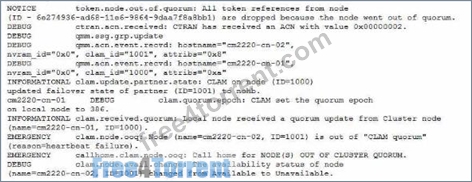
Referring to the exhibit, which statement is correct?
- A. No takeover event will occur and NAS data UFs will not be accessible.
- B. Both nodes race to takeover the other, one node will takeover the other node.
- C. All nodes in the cluster reset and NAS data UFs are not accessible after reboot.
- D. NAS data UFs are accessible on only the node that has Epsilon.
Answer: D
Explanation:
The two throughput elements that are controlled by host applications are operation size and concurrency. Operation size refers to the amount of data that is transferred in a single I/O request, and concurrency refers to the number of I/O requests that are issued simultaneously. Both of these factors affect the throughput of a host application, as they determine how much data can be sent or received within a given time period. Larger operation sizes and higher concurrency can increase the throughput, but they may also increase the latency and resource consumption12. Reference: 1: NetApp Performance Analysis on Data ONTAP - Chapter 3: Host-Side Performance 2: NetApp Performance Analysis on Data ONTAP - Chapter 4: Storage System Performance
NEW QUESTION # 37
......
Accurate & Verified Answers As Seen in the Real Exam here: https://pass4sures.free4torrent.com/NS0-593-valid-dumps-torrent.html