

[Jun 12, 2026] Get New 1z0-1057-25 Practice Test Questions Answers
1z0-1057-25 Dumps and Exam Test Engine
NEW QUESTION # 62
Your organization has been awarded a new contract based on which you are allowed to sell:
* Items not tracked in inventory
* Inventory items
* Services
Which contract structure would fulfill your requirement of item sales? (Choose the best answer.)
- A. Create two contract lines with a line type each of "sell intent, item, project-based' and "subscription, project-based, sell".
- B. Create two contract lines with a line type each of "free-form, project-based buy agreement" and "bundle sell, project-based".
- C. Create two contract lines with a line type each of "sell intent, free-form, project-based" and "sell intent, item, project-based".
- D. Create two contract lines with a line type each of "product, project-based, sell agreement, standalone" and "sell intent, item, project-based".
Answer: C
Explanation:
To sell items not tracked in inventory, inventory items, and services, you can create two contract lines with different line types. The line type of "sell intent, free-form, project-based" allows you to sell any item or service without specifying the item number or quantity. The line type of "sell intent, item, project-based" allows you to sell inventory items by specifying the item number and quantity. Both line types are project- based, meaning they are linked to a project and generate revenue based on project performance. Reference:
https://docs.oracle.com/en/cloud/saas/project-portfolio-management/20c/oapfm/manage-contracts.
html#OAPFM2355835
NEW QUESTION # 63
You want to export your project plan to Oracle Project Financial Management Cloud after initial scheduling is complete in Microsoft Projects. Identify three conditions that must be met for exporting milestone tasks. ( Choose three.)
- A. percent work complete values of 0 or 100 percent
- B. lowest-level tasks set up with zero duration
- C. only one labor resource assignment with 0 effort
- D. lowest-level tasks set up with non-zero duration
- E. only one labor resource assignment with 100 effort
Answer: A,B,C
Explanation:
Ref: https://docs.oracle.com/en/cloud/saas/project-portfolio-management/19a/oapex/define-project- management-configuration.html#OAPEX1357147 Topic - Microsoft Project Prevalidation: Explained The following table describes Prevalidation rules for tasks and resource assignments.
Level
Rule
Lowest-level tasks
One labor and multiple expense resources are allowed for a lowest-level task. Remove other resources.
Summary tasks
Only one labor resource with zero allocation is allowed for a summary task. Remove all other resources.
Milestone tasks
No subtasks are allowed under milestone tasks. Milestones must be lowest-level tasks.
Milestone tasks
Milestone tasks must have zero duration.
Milestone tasks
Only one labor resource, with zero effort, is allowed for a milestone task. Remove all other resources.
When exporting milestone tasks, ensure that the tasks:
* Are lowest-levels task with zero duration, that is, the same start and finish dates.
* Have only one labor resource assignment with zero effort.
* Have percent work complete values of 0 or 100 percent. Any other values are set to zero before export.
NEW QUESTION # 64
You have been hired as a project manager for implementing the Project Financial Management and Project Execution Management offering by an organization. The Chief Information Officer of the deploying organization has requested you to explain the benefits of using the implementation project-based approach over the functional area-based approach.
Which two are the main benefits of using the implementation projects within Functional Setup Manager?
(Choose two.)
- A. Implementation Project gives you the flexibility to set up different functional areas of the offering at different times.
- B. Implementation Project helps you to monitor progress of the setup tasks.
- C. Implementation Project helps you to use the manage setup data entry in bulk option.
- D. Implementation Project helps in assigning responsibility of managing setup data to a broad group of users.
Answer: B,D
Explanation:
Some of the main benefits of using the implementation projects within Functional Setup Manager are:
* Implementation Project helps in assigning responsibility of managing setup data to a broad group of users. You can assign tasks to different users who are responsible for entering and validating setup data for different functional areas of the offering.
* Implementation Project helps you to monitor progress of the setup tasks. You can track the status and completion percentage of each task and view the dependencies and prerequisites among tasks.
Implementation Project does not give you the flexibility to set up different functional areas of the offering at different times, as this is determined by the configuration package that you select for your implementation. Implementation Project does not help you to use the manage setup data entry in bulk option, as this is a separate feature that allows you to import and export setup data across instances using spreadsheets. Reference: https://docs.oracle.com/en/cloud/saas/project-portfolio-management/20c
/oapfm/implement-project-financial-management-applications.html#OAPFM2356051
NEW QUESTION # 65
While creating a new project template, you notice that a default Asset Cost Allocation method is being automatically associated. Identify the source setup from which the default value is being inherited. (Choose the best answer.)
- A. project type
- B. project unit
- C. project organization
- D. project classification
Answer: A
Explanation:
Ref: https://docs.oracle.com/en/cloud/saas/project-portfolio-management/19b/oapjf/define-project.
html#OAPJF220111
Asset Cost Allocation Methods
The asset cost allocation method determines how indirect or common costs incurred on a project are allocated to multiple assets.
You can specify an asset cost allocation method to enable Oracle Fusion Project Costing to automatically allocate unassigned asset lines and common costs across multiple assets. Unassigned asset lines typically occur when more than one asset is assigned to an asset grouping level.
Projects and project templates inherit a default asset cost allocation method from the associated project type.
You can override the default at the project level. If you use capital events to allocate costs, then you can also override the asset cost allocation method at the event level Asset Cost Allocation Methods The following table describes the available asset cost allocation methods.
Method
Basis of Cost Allocation
Actual Units
Number of units defined for each asset
Current Cost
Construction-in-process (CIP) cost of each asset
Estimated Cost
Estimated cost of each asset
Standard Unit Cost
Combination of the standard unit cost and the number of units defined for each asset Spread Evenly Equal allocation of cost to each asset
NEW QUESTION # 66
Your customer wants to calculate Estimate to Complete (ETC) as the difference between Current Planned Cost and Actual Cost. In Progress Settings, which option would you use in conjunction with the ETC method to meet this requirement? (Choose the best answer.)
- A. Remaining Plan
- B. Manual Entry
- C. Cost
- D. Effort
Answer: C
Explanation:
Reference https://ppm-help.saas.hpe.com/en/9.42/Help/Content/UG/PjMUG/view_pj_cost_data_costtab.htm Below is an example of the Financial Summary view on the Cost tab of the Project Overview page.
https://admhelp.microfocus.com/ppm/en/9.42/Help/Content/UG/PjMUG/images
/ProjectOverviewPage_CostTab.gif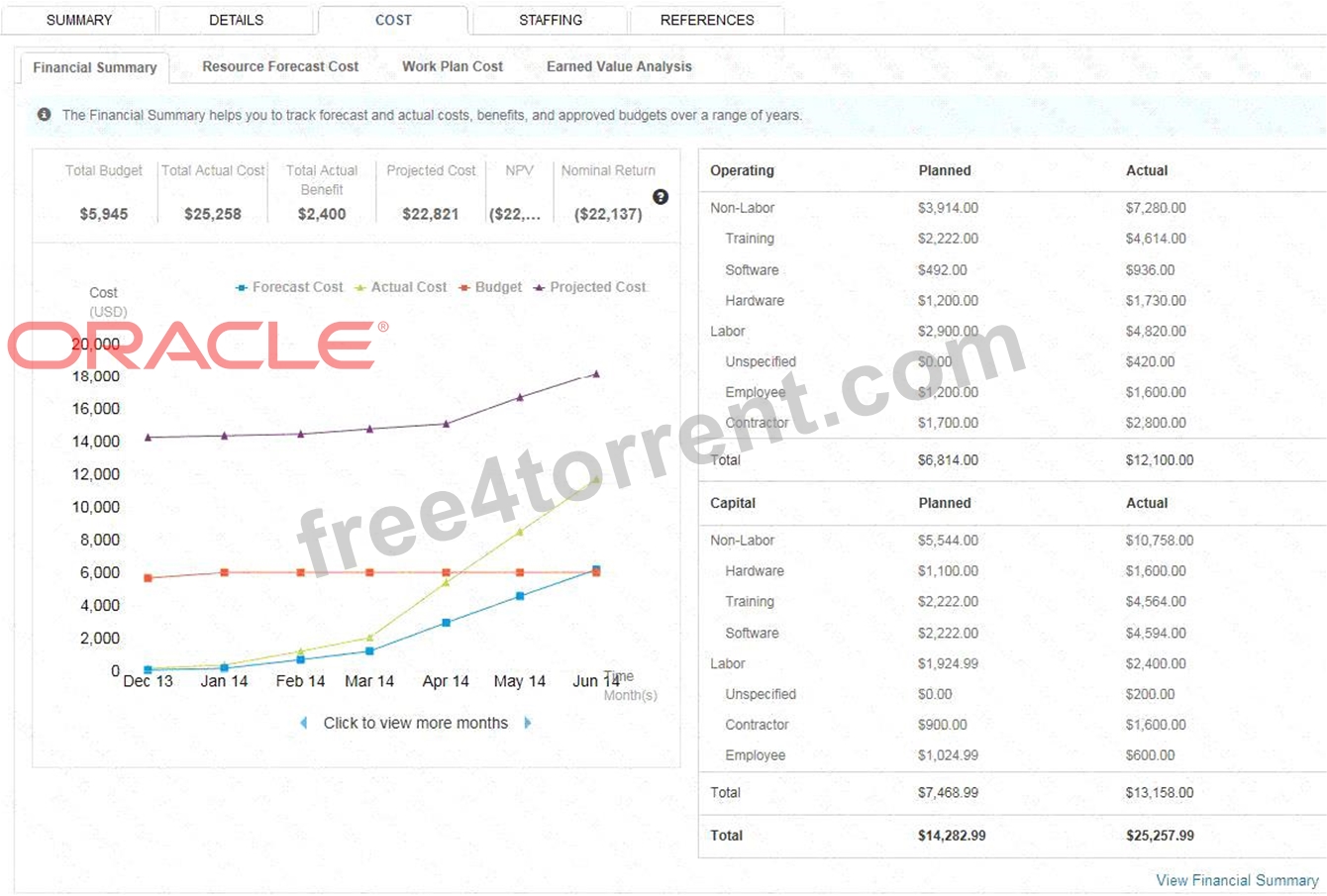
NEW QUESTION # 67
Which three tools are available for accessing REST APIs?
- A. Oracle Transactional Business Intelligence
- B. Programming Language
- C. cURL
- D. Web Browser
Answer: B,C,D
Explanation:
Ref: https://docs.oracle.com/en/cloud/saas/project-portfolio-management/18b/fapap/Use_cURL.html
REST API = REpresentational State Transfer (REST) Application Programing Interface (API)
NEW QUESTION # 68
Which three features are part of Oracle Fusion Functional Setup Manager?
- A. export and import services for setup data migration between environments
- B. updating an implementation project task list by changing the opt-in configuration to suit the latest requirements
- C. modifying an existing implementation project task list by selecting more functional areas when needed
- D. feature opt-in for a best fit configuration
- E. guided task list for end-to-end setup requirements
Answer: A,D,E
Explanation:
https://docs.oracle.com/en/cloud/saas/applications-common/r13-update17d/oafsm/applications-cloud-using-functional-setup-manager.pdf Functional Setup Manager offers the following:
* Standardized application configuration and setup experience
* Feature opt-in for a best fit configuration
* Flexible processes for managing setup:
# Setup by functional areas for an adopt-as-you-go approach
# Implementation projects to manage setup
# Upload file to enter setup data in bulk
* Guided task list for end-to-end setup requirements
* Export and import services for setup data migration between environments
* Comprehensive reporting on setup data
NEW QUESTION # 69
Your client organization has recently undergone a restructuring exercise that has resulted in the creation of new jobs. The Resource Breakdown Structure (RBS) was previously created with existing jobs, and now the new jobs have been added to the existing Resource Breakdown Structure.
Identify the correct statement about the RBS and new resources. (Choose the best answer.)
- A. If the "Allow resource changes at project level" option is set to No for the RBS, then the resources added to the Planning Resource Breakdown Structure are automatically available for use on the projects.
- B. If the "Allow resource changes at project level" option is set to No, the new resources and resource formats that are added to a Planning Resource Breakdown Structure for one project are not available for other projects.
- C. If the "Allow resource changes at project level" option is enabled for the RBS, the new resources added at project level are automatically reflected in the RBS.
- D. If the "Allow resource changes at project level" option is set to Yes for the RBS, the new resources are available automatically at project level.
Answer: A
Explanation:
Ref: https://docs.oracle.com/en/cloud/saas/project-portfolio-management/19a/fapfm/implementing-project-financial-management-applications.html#FAPFM969761
Topic - Entering Planning Resource Breakdown Structure Details
* Click Navigator > Setup and Maintenance, and search for the Manage Planning and Billing Resource Breakdown Structures task.
* Click the Manage Planning and Billing Resource Breakdown Structures link.
Use the Manage Planning and Billing Resource Breakdown Structures page to create new planning resource breakdown structures and to review existing planning and billing resource breakdown structures.
* Click the Create icon in the Planning Resource Breakdown Structures section.
* Use the Create Planning Resource Breakdown Structure: Basic Information page to provide basic resource breakdown structure information including the name, active dates, and project unit.
* Enter a planning resource breakdown structure name and select a date from which the resource breakdown structure is available for use.
* Optionally, provide a description and a date to which the planning resource breakdown structure is available for use.
* Select a project unit. Only projects created for the selected project unit can use this planning resource breakdown structure.
* If you want to allow project managers to add planning resources at the project level, then select the Allow resource changes at project level check box.
Tip: Changes at the project level don't move back to the parent planning resource breakdown structure.
Deselect this option to ensure all project using the planning resource breakdown structure use the same resources.
* Optionally, select a Job Set as a source of jobs for creating planning resources on your planning resource breakdown structure.
* Click Save.
NEW QUESTION # 70
Your customer wants a team member who is assigned to a project to be able to create and submit a forecast, but not to be able to approve the forecast. What is the default project role that you should assign to the person in the project to meet this requirement? (Choose the best answer.)
- A. Project Manager
- B. Project Accountant
- C. Project Application Administrator
- D. Project Administrator
Answer: D
Explanation:
Ref: https://docs.oracle.com/en/cloud/saas/project-portfolio-management/19b/oapjm/project-administrator-job- role.html#Project_Administrator_privileges Project Manager has duty role 'Project Forecast Approval Duty' assigned but Project Administrator has duty role 'Project Forecast Inquiry Duty' - no approval authority Both roles have duty role 'Project Forecast Management Duty' which enables them to Allow creation, submission, update, and deletion of working versions of project forecasts. (Cloud _Roles_Duties.xlsx)
NEW QUESTION # 71
You search for resources to fulfill a project resource request but are unable to proceed after receiving the following error message: "The search for resources cannot be completed because the project resource search index is not available. Contact your help desk." Identify the cause for this error message. (Choose the best answer.)
- A. The most recent update of the index finished successfully.
- B. The index has been built.
- C. The index is in the process of being updated.
- D. The index is not in the process.
Answer: C
Explanation:
Ref: https://docs.oracle.com/en/cloud/saas/project-portfolio-management/19a/fapfm/implementing-project- execution-management-applications.html#FAPFM1724547 Topic - Submitting the Process to Maintain Project Resource Search Index: Procedure Submit the Maintain Project Resource Search Index job set to update the resources that appear on the Search and Evaluate Resources page when a resource manager searches for resources to fulfill project resource requests. The job set consists of a set of processes that facilitate efficient and rapid searches for qualified resources.
Resource managers can't search for resources or view resource details if the search index isn't available for a project resource request with qualifications or keywords. For project resource requests without qualifications and keywords, resource managers can search for and evaluate resources based on resource availability even if the search index isn't current or available.
Caution: The search index isn't available if the Maintain Project Resource Search Index job set process fails, or while the process is running.
NEW QUESTION # 72
Your customer has the following setups on the project plan type that they are using for their projects:
Use Task Planned Dates as Task Assignment Dates = Yes
Automatically Roll Up Task Planned Dates = Yes
Synchronize Task Transaction Dates with Planned Dates = No
With these setups in place, you perform the following actions:
1. Create a new subtask (Sub Task 1) with a start date of 15-Jun-2016 on the project that has as start date of
01-Jul-2016.
2. Create another new subtask (Sub Task 2) after the previous action is saved.
What would the correct behavior of the application be after these actions? (Choose the best answer.)
- A. After the creation and saving of Sub Task 1, Task Start Date would be changed to 01-Jul-2016 and Sub Task 2 would be created with 01-Jul-2016.
- B. After the creation of Sub Task 1, Project Start Date would be changed to 15-Jun-2016 and Sub Task 2 would be created with 15-Jun-2016.
- C. After the creation of Sub Task 1, Project Start Date would remain unchanged as 01-Jul-2016 and Sub Task 2 would be created with 15-Jun-2016.
- D. Project Start Date would remain unchanged as 01-Jul-2016 for both actions but the start dates on both subtasks would remain 15-Jun-2016.
Answer: B
Explanation:
Ref: https://docs.oracle.com/en/cloud/saas/project-portfolio-management/19b/oapjf/manage-project-plan- tasks-and-task-assignments.html#OAPJF75076
NEW QUESTION # 73
You are implementing Project Portfolio Management (PPM) for a professional services firm. The firm rents multiple buildings for its operations. At the end of each month, they review the rent expense for the month and want to allocate the rental cost to all the projects and tasks that are executed by associates in each of the buildings. The source amounts must be proportionally allocated to the tasks based on the raw costs of the tasks from the previous month. Considering that all these costs are in General Ledger, what three allocation setups should you complete in PPM? (Choose three.)
- A. Allocate rental costs once each accounting period by using the "full" allocation method.
- B. Allocate to all eligible tasks and prorate the allocation by the total actual raw cost accrued for each task during the previous accounting period.
- C. Define allocation basis by using Actual Amounts with a period-to-date amount class.
- D. Allocate rental costs once each accounting period by using the "spread evenly" allocation method.
- E. Define allocation basis by using Actual Amounts with a project-to-date amount class.
Answer: A,B,C
Explanation:
To allocate the rental cost to the projects and tasks based on the raw costs of the tasks from the previous month, you need to do the following:
* Allocate rental costs once each accounting period by using the "full" allocation method. This method allocates the entire source amount to the target tasks in one run.
* Allocate to all eligible tasks and prorate the allocation by the total actual raw cost accrued for each task during the previous accounting period. This ensures that the source amount is proportionally allocated to the tasks based on their relative raw costs.
* Define allocation basis by using Actual Amounts with a period-to-date amount class. This allows you to use the actual raw costs of the tasks as the basis for allocation and to use the amounts from the previous accounting period. Reference: https://docs.oracle.com/en/cloud/saas/project-portfolio-management/20c
/oapfm/manage-project-costs.html#OAPFM2355951
NEW QUESTION # 74
You are managing a project based on a Waterfall model. You define a project and a project plan in Oracle Project Portfolio Management with tasks and subtasks applicable to each of the phases of the project:
Initiation, Discovery, Design, Build, Test, and Deploy. As a project manager, you want to define deliverables for your project requirements that are elucidated during the Discovery phase of your project. You now want to understand how the inheritance between requirements, tasks, and deliverables works. Identify the two correct statements in this respect. (Choose two.)
- A. You associate a deliverable with a task, independent of associating a requirement with a task.
- B. A deliverable associated with a requirement is not automatically associated with the tasks created for that requirement.
- C. The association of a deliverable with a task is dependent on associating a requirement with a task.
- D. A deliverable associated with a requirement is automatically associated with the tasks created for that requirement.
Answer: A,B
Explanation:
Ref: https://docs.oracle.com/en/cloud/saas/project-portfolio-management/19b/oapem/define-project- deliverables.html#OAPEM1122079 Associate deliverables with one or many tasks or requirements at any level. Associate existing deliverables to tasks or requirements or create deliverables directly for tasks or requirements. You can delete a deliverable in New status if it is not associated with tasks or requirements.
Can deliverables for projects and tasks be inherited from associated requirements?
No. A deliverable associated with a requirement is not automatically associated with the tasks created for that requirement.
You associate a deliverable with a task, independent of associating a requirement with a task.
NEW QUESTION # 75
Which three are project gate statuses? (Choose three.)
- A. Closed
- B. In Review
- C. Open
- D. Approve
- E. Draft
Answer: A,B,C
Explanation:
Project gate statuses are values that indicate the progress or completion of a project gate. A project gate is a checkpoint that marks the end of a phase or stage in a project lifecycle. Three of the project gate statuses are:
* Open: This status indicates that the project gate is not yet ready for review or approval.
* In Review: This status indicates that the project gate is under review or approval by the gate reviewers or approvers.
* Closed: This status indicates that the project gate has been reviewed or approved and the project can move to the next phase or stage. Approve and Draft are not project gate statuses, but actions that can be performed on a project gate. Approve is an action that allows a gate approver to approve a project gate and change its status to Closed. Draft is an action that allows a gate owner to create or edit a project gate and change its status to Open. Reference: https://docs.oracle.com/en/cloud/saas/project-portfolio- management/20c/oapfm/manage-project-execution.html#OAPFM2356251
NEW QUESTION # 76
You have a small project for a period of five months. Your budget amount for each month is spread evenly and is $1000 per month. The first month actual expense is $800 and there is a commitment for $600. Now you generate a forecast at the beginning of the second month. Identify the monthly Estimate-To-Complete (ETC) amount that the application would calculate for the remaining four periods, when the ETC generation method includes commitments. (Choose the best answer.)
- A. 0
- B. 1
- C. 2
- D. 3
Answer: C
Explanation:
Budget 5,000Actuals 800Commitment 600
ETC = Budget - Actuals - Commitment
ETC = 5,000-800-600 = 3,600 Budget available for next 4 months = 3,600/4 = 900/month
NEW QUESTION # 77
......
2026 New Free4Torrent 1z0-1057-25 PDF Recently Updated Questions: https://pass4sures.free4torrent.com/1z0-1057-25-valid-dumps-torrent.html